
Too Many Tools? Rethinking the Technology Behind Fund Reporting
By Steve Verlinden, Principal Presales Consultant, Multifonds Global Reporting
Abstract
Fund reporting has become more complex as regulatory obligations, investor transparency expectations and cross-border distribution have expanded. Asset managers and fund administrators now produce a continuous flow of financial, regulatory and investor reporting across multiple jurisdictions, formats and languages.
To meet these demands, many firms have assembled specialised reporting tools across the lifecycle. Individually, those applications may work well. Collectively, they can create fragmented data, duplicated logic, complex integrations and limited end-to-end visibility. The central question is therefore no longer simply whether each reporting tool performs its task, but whether the reporting architecture as a whole can remain consistent, scalable and controlled as requirements grow.
Key takeaways
• Fund reporting has evolved from periodic financial statements into a continuous, multi-audience operational process.
• A fragmented reporting technology stack can create data consistency, integration, governance and maintenance challenges as reporting volumes grow.
• Integrated reporting architectures aim to centralise data ingestion, validation logic, workflow orchestration and document generation.
• Automation and exception-based processing can shift reporting teams from routine verification toward analysis and oversight.
• AI is emerging as a supporting capability for anomaly detection, classification, structured narrative commentary and multilingual reporting workflows.
Why has fund reporting become more complex?
Fund reporting has become more complex because it now serves more audiences, more regulatory requirements and more distribution markets than when reporting was primarily a periodic financial statement exercise.
What was once primarily a periodic exercise focused on financial statements has evolved into a continuous flow of documentation addressing regulators, investors, auditors, and internal governance structures. Annual reports, investor factsheets, portfolio disclosures, statistical filings, and regulatory submissions must all be produced within strict timelines and often across multiple jurisdictions.
Regulation is a major driver. European asset managers may need to address frameworks such as AIFMD, UCITS, SFDR and MiFID alongside cross-border tax and transparency requirements such as FATCA and CRS.
Supervisory authorities require extensive disclosure across a wide range of reporting formats.
At the same time, investors increasingly expect greater transparency regarding portfolio composition, performance drivers, and risk exposure. In many cases, these reports must also be adapted for different distribution markets and produced in multiple languages.
The result is a reporting ecosystem that must serve regulatory, operational and investor communication needs at the same time.
What is a fund reporting technology stack?
A fund reporting technology stack is the combination of systems, data pipelines, workflow tools, document-production software and compliance applications used to create, validate and distribute fund reports.
At the foundation of this infrastructure are portfolio and accounting platforms, which store the financial and investment data underlying many reporting processes.
Data is then commonly extracted and processed through data warehouses or extract, transform and load (ETL) pipelines before reporting production. Narrative and financial sections may be assembled in Microsoft Word templates, while calculations and reconciliations often take place in Microsoft Excel.
Investor-facing publications such as factsheets or marketing reports may rely on publishing tools, while regulatory filings are sometimes generated through specialised compliance systems or external service providers.
Over time, this layered model can result in a reporting stack made up of multiple specialist applications, data transformations and operational hand-offs.
Individually, these tools may perform their roles effectively. Collectively, however, they can create a fragmented operational environment that becomes harder to manage as reporting volumes and requirements grow.
When do multiple reporting tools become an operational problem?
Multiple reporting tools become an operational problem when the complexity of connecting, governing and maintaining them begins to outweigh the benefits of specialisation. The issue is often not any one application, but the dependencies between them.
• Data consistency: When reporting processes span multiple systems, each may apply its own transformation rules, validation logic and formatting structures. The same data element can therefore be processed differently depending on where it is handled.
• Integration management: Each reporting tool must connect with upstream data sources and downstream outputs through APIs, ETL processes or scheduled data exchanges. As the number of tools grows, so does the network of integrations that must be maintained and monitored.
• Operational governance: Reporting production can involve multiple teams responsible for different systems across the reporting chain. Without a unified production environment, maintaining end-to-end visibility and control becomes more difficult.
• Technology footprint: Every application must be maintained, updated, secured and supported. User access, IT security policies, system compatibility and vendor updates all add to the operational burden and can make the infrastructure harder to adapt to new requirements.
• Traceability: Even basic questions, such as finding the source of a discrepancy or confirming the latest version of a document, may require teams to navigate several tools and workflows.
As reporting requirements continue to expand, these structural complexities become increasingly visible and can limit scalability.
How is technology reshaping fund reporting infrastructure?
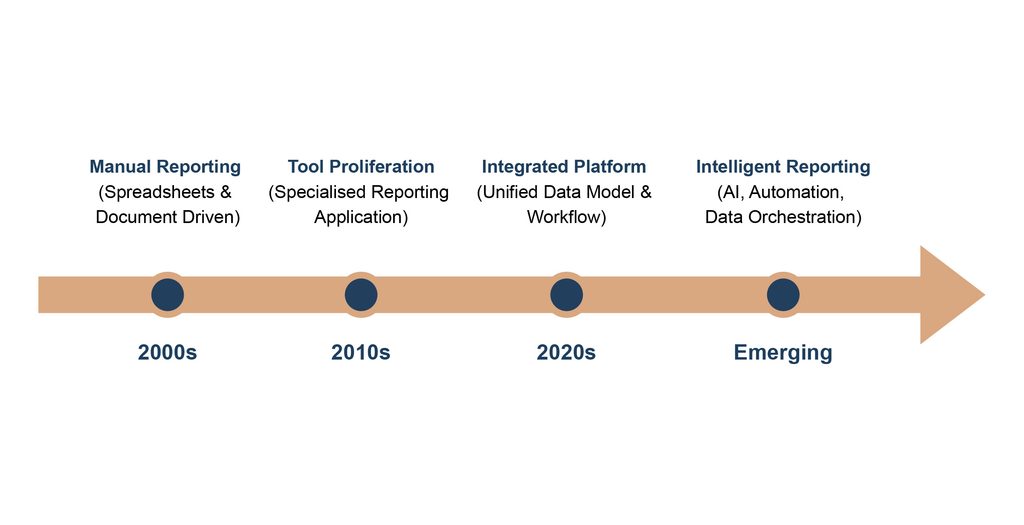
Fund reporting technology is moving from fragmented point solutions toward more integrated architectures that centralise data, validation, workflow and document production.
Rather than adding a new tool for every emerging requirement, some firms are exploring architectures that centralise key elements of the reporting process, including data ingestion, validation logic, workflow orchestration and document generation, within a more unified environment.
Centralised data models are becoming a key element of this transformation. By structuring multiple reporting outputs around a shared data foundation, organisations can improve consistency across documents and reduce duplication of processing logic.
Automation technologies are also transforming reporting workflows. Modern reporting platforms can orchestrate entire production cycles, coordinating data imports, validation controls, calculations, and document generation within a single workflow.
Connect with the author

Last updated in Aug 2026.